
Fiber Rich Milk From Lactose: Mengniu's Innovation
DAIRY & ALTERNATIVES
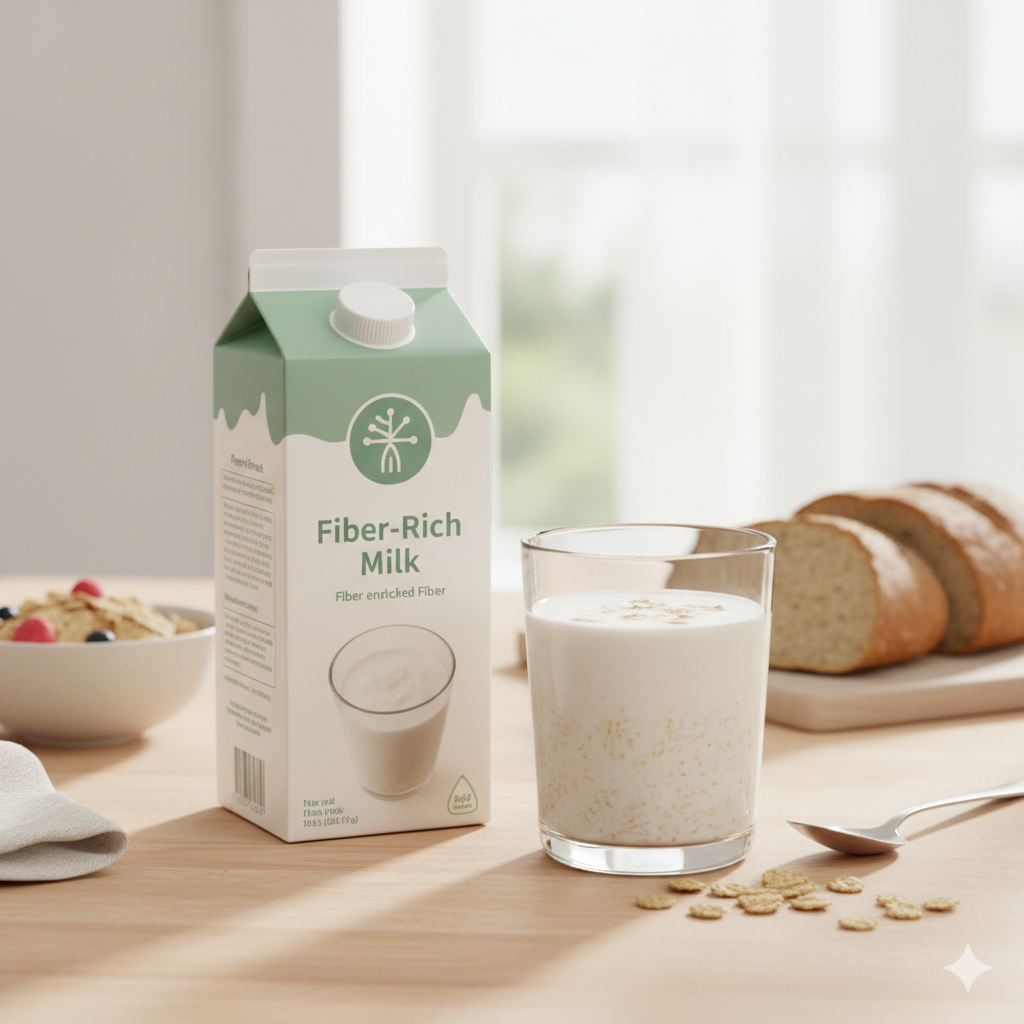
This is an AI generated illustration and does not represent actual product or service.
The modern dairy aisle is full of choices: high-protein for athletes, lactose-free for the intolerant, and fiber-fortified for digestive health. But what if a single product could deliver all three benefits inherently, without relying on artificial additives? A new patent from Mengniu Dairy reveals a sophisticated bioprocessing technique that does just that, transforming ordinary milk into a "triple-purpose" nutritional powerhouse.
The Challenge: The Lactose-Fiber Trade-Off
For years, dairy producers have faced a fundamental trade-off when using enzymes to tackle lactose. The enzyme β-galactosidase (often called lactase) can do two things:
Hydrolyze Lactose: Break it down into simple sugars (glucose and galactose) to make "lactose-free" milk.
Transgalactosylate: Use the released galactose to build larger, beneficial carbohydrate chains called Galactooligosaccharides (GOS)—a premium prebiotic dietary fiber.
The problem is, these processes compete. As lactose levels drop during prolonged enzyme treatment, the same enzyme starts to break down the newly formed GOS fibers it just created. This clash limits both the final GOS yield (typically below 30%) and forces a compromise: you can't achieve truly "zero lactose" (≤0.5g/100mL) without sacrificing most of the valuable fiber. Most high-protein milks made via ultrafiltration also lack significant native fiber.
Mengniu's Solution: The "Cycle, Separate, Repeat" Strategy
Mengniu's innovation is a clever three-stage, coupled enzyme-ultrafiltration (UF) process that breaks the cycle of competition. Instead of one long reaction, they strategically interrupt it.
The Core Process:
Stage 1: Treat raw milk with β-galactosidase. Stop the reaction early when lactose drops to 2-3g/100mL—a point where GOS synthesis is still efficient. Immediately ultrafilter the mixture. The UF membrane (1-20 Dalton) captures the newly formed, high-molecular-weight GOS fibers (tri-saccharides and larger) and all proteins/fats/calcium in the retentate. The smaller sugars (remaining lactose, glucose, simple galactose) pass into the permeate.
Stage 2: Take the sugar-rich permeate from Stage 1 and add fresh enzyme. Run a second reaction, stopping at 0.8-1.2g lactose/100mL. Ultrafilter again. This captures a second batch of GOS in a new retentate.
Stage 3: Take the final permeate and run a third, final enzyme treatment to drive lactose down to ≤0.5g/100mL (achieving "zero lactose" status). A final UF step captures any last GOS formed.
Final Step: All three GOS-and-nutrient-rich retentates are combined. The final, ultra-low-lactose permeate from Stage 3 is added back to adjust consistency. The result is a recombined milk with spectacularly enhanced native nutrition.
The Staggering Results: Redefining "Enhanced Milk"
Sky-High Fiber: GOS (tri-saccharide+) content reaches 5.5-6.5g/100mL, with a synthesis efficiency of over 60% (vs. typical <30%). This is a transformative level of native prebiotic fiber.
True Zero-Lactose: Final lactose is reliably ≤0.5g/100mL.
High-Protein & Calcium: By using UF retentates, the process naturally concentrates milk's native proteins to ≥5.0g/100mL and calcium to ≥170mg/100mL.
Superior Taste: Consumer sensory tests showed significantly higher preference for this milk, likely because the process minimizes bitter byproducts and optimizes the sugar profile for a cleaner, sweeter taste.
Why This Matters for the Food Industry
Clean-Label Superfood: This creates a "native supermilk" where all enhancements come from rearranging milk's own components, not adding external powders or isolates. It's the ultimate clean-label functional dairy.
Gut-Health Frontier: The high levels of native GOS position dairy as a major player in the gut health and prebiotic market, competing directly with supplements and fiber-fortified beverages.
Process Efficiency: It turns a waste product of traditional UF (the sugar-rich permeate) into a valuable feedstock for generating more premium product (fiber), improving overall yield and economics.
Category Redefinition: It blurs the lines between lactose-free milk, high-protein milk, and functional beverage, creating a new, premium multi-benefit category.
By intelligently decoupling the competing reactions of lactose breakdown and fiber synthesis through staged ultrafiltration, Mengniu has solved a long-standing technical dilemma. The outcome is not just an incremental improvement, but a new class of dairy: a truly native, high-fiber, zero-lactose, high-protein milk that delivers on multiple health trends simultaneously from a single, simple ingredient list: milk.


Trending Stories
Latest Stories
Inspiring the food industry by showcasing hidden and valuable innovations from patents.
Subscribe to our monthly newsletter and never miss a story
We promise, we won't spam you!
We care about your data in our privacy policy.


FoodTechForesight.com
Founder and Editor