
How Pretabolic Engineered a Meal Replacement Bar Around EU Nutrition Law
ALTERNATIVE PROTEINSDAIRY & ALTERNATIVES CONFECTIONARY
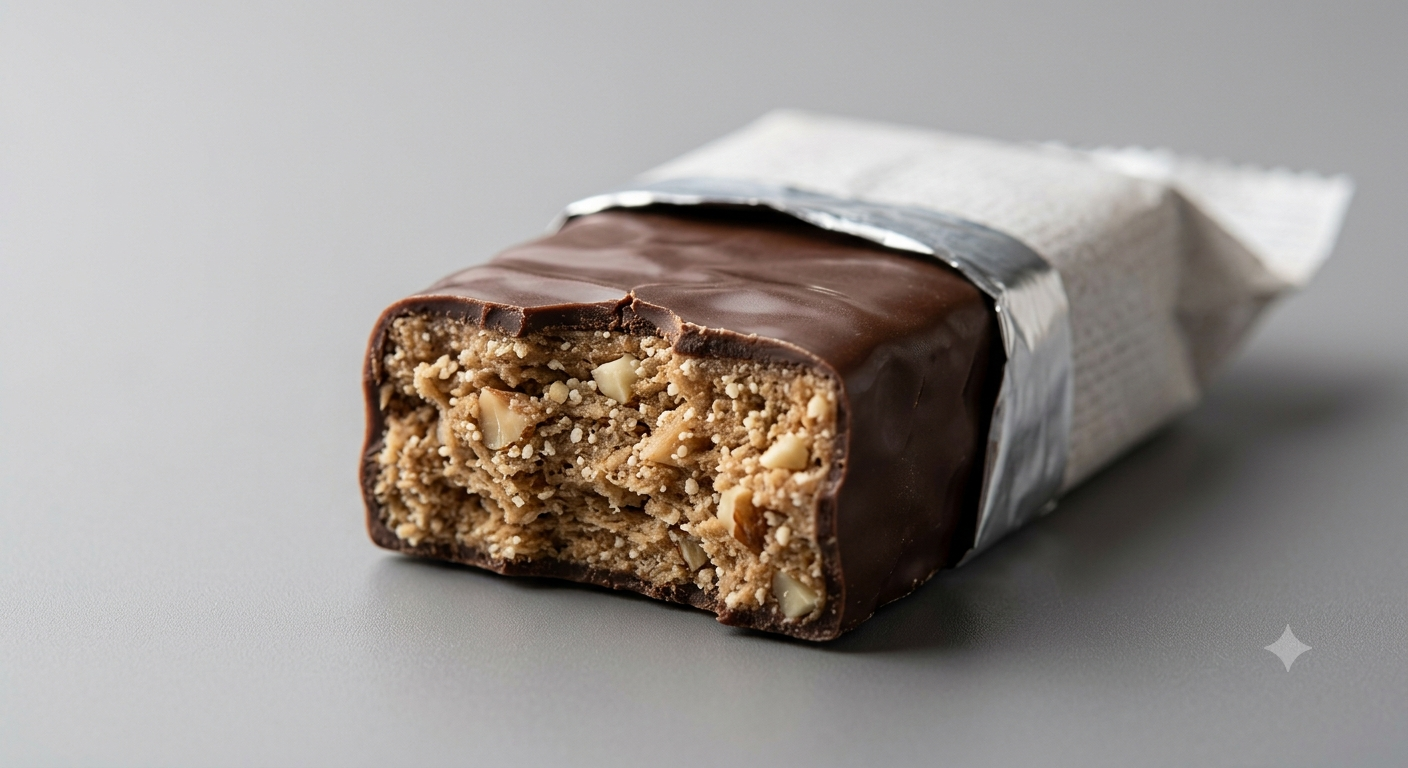
This is an AI generated illustration and does not represent actual product or service.
Meal replacement products live inside a narrow regulatory box. In the EU, a product can only call itself a "meal replacement for weight control" if it hits specific numbers: 200–250 kcal per meal, no more than 30% of energy from fat, at least 1 g of linolenic acid, and 25–30% of total energy from protein. That combination is harder to hit than it looks, especially at a serving size people will actually eat as a full meal rather than a snack.
A newly published European patent application from Cologne-based Pretabolic Health Science GmbH (EP 4 775 047 A1) sets out to solve that problem — and does it by leaning hard on a quirk of EU food labeling rules rather than on a novel ingredient.
The Core Idea: Fiber Doesn't Count the Way Sugar Does
Pretabolic's approach starts from a simple but underused fact: under EU Regulation No. 1169/2011, dietary fiber is calculated at a flat 2 kcal/g, regardless of how many of those grams actually get absorbed. Digestible carbohydrates, by contrast, are counted at roughly 4 kcal/g because the body extracts most of that energy.
That gap between "labeled calories" and "metabolized calories" is the entire mechanism of this patent. The claimed food — described as a drink, bar, dessert, soup, sauce or paste — contains:
6 wt.% or less digestible, energy-providing carbohydrates (starches, sugars, and their metabolizable sugar alcohols)
A high proportion of non-metabolizable carbohydrates — at least 30 wt.%, preferably 40–45 wt.%, coming from resistant starch, inulin/chicory fiber, polydextrose, maltodextrin fractions, glycerin, and similar fiber and sugar-alcohol sources
25–50 wt.% protein, drawn from dairy, whey, pea, canola, or soy sources
By pushing carbohydrate content into the "non-metabolizable" bucket, the formulation keeps the labeled energy density low enough to fit a 200–250 kcal meal replacement portion, while still delivering enough bulk and protein to function as a genuine meal rather than a diet shake.
Why This Is Harder Than It Sounds
The patent's background section makes a claim worth taking seriously: despite substantial prior art on fasting-support foods (it cites an earlier patent covering added free fatty acids for patients with metabolic or absorption disorders), nobody had actually published a formulation that satisfies the full EU meal-replacement criteria simultaneously. Hitting the protein percentage, the fat ceiling, the linolenic acid floor, and the calorie ceiling all at once, in a product with the mouthfeel and stability of a real bar or drink, is a formulation puzzle — not just a "reduce sugar" exercise.
The four worked examples in the patent (a pea-protein vegan bar and three chocolate-coated variants — coconut, salted caramel, and vegan almond) show how tight the margins are. In Example 1, a 70 g bar delivers 211 kcal, 16.8 g protein (31.8% of energy — inside the 25–30% band), 7 g fat (29.9% of energy — just under the 30% ceiling), and 31.8 g of fiber. That's a remarkable fiber load for a snack-format product — for context, that's roughly the entire daily recommended fiber intake for an adult in a single bar.
Where the Formulation Gets Its Fiber
The recipe engineering is genuinely interesting from an ingredient-sourcing perspective. Resistant starch and oligofructose form the backbone (43% and 9.4% respectively in Example 1), doing double duty as bulking agent and the primary reason the calorie count stays low under EU labeling rules. Almond paste supplies both fat and the linoleic acid needed to satisfy the essential-fatty-acid requirement, while also contributing its own fiber. Pea protein isolate carries the protein load in the vegan version, propped up with added N-acetyl-L-cysteine — a synthetic amino acid included specifically to compensate for pea protein's comparatively low biological value, since the EU meal-replacement standard implicitly assumes reasonably complete protein.
That detail is worth flagging for formulators: the patent isn't just balancing macros, it's correcting an amino acid quality gap with a targeted additive, which is a more sophisticated (and more defensible, IP-wise) move than simply upping the pea protein percentage.
The dairy-based variants (Examples 3 and 4) swap in milk protein and whey protein concentrate, with polydextrose and chicory fiber carrying the non-metabolizable carbohydrate load instead of resistant starch — suggesting the platform is meant to be ingredient-flexible across at least two protein sourcing strategies, animal and plant.
Commercial Read: A Compliance Tool as Much as a Recipe
It's worth being clear about what this patent actually protects. It isn't a new ingredient or a new processing technology — it's a formulation strategy for satisfying a specific regulatory definition. That has a few implications for anyone tracking this space:
The addressable market is EU-labeling-specific. The "meal replacement for weight control" claim only matters where Regulation (EU) 2016/1413 applies. A US or UK brand copying the macro ratios wouldn't get the same regulatory benefit unless local rules treat fiber calories the same way — worth checking before assuming portability.
Formulation complexity is real but not exotic. Every ingredient used (resistant starch, inulin, polydextrose, pea and whey protein isolates, almond paste) is commercially available at scale from established suppliers. The barrier here isn't sourcing — it's getting the ratios right without producing a bar that tastes like fiber supplement and behaves badly in shelf-life testing. Anyone attempting to replicate this should expect real R&D time in texture and stability, even though no ingredient itself is novel.
High fiber loads carry a GI tolerability question the patent doesn't address. A bar delivering over 30 g of fiber per serving — resistant starch, inulin, polydextrose all included — sits well above typical single-serving fiber tolerance thresholds for many consumers. Resistant starch and inulin are both well-documented for causing bloating and gas at high single doses in people not accustomed to them. This is a real go-to-market consideration that the patent, understandably, doesn't discuss, since patents protect composition and use, not consumer experience.
The N-acetyl-L-cysteine addition is a detail worth watching regulatorily. Adding an isolated amino acid to correct protein quality is a reasonable formulation technique, but NAC's status varies by jurisdiction — it has faced supplement-market scrutiny in the US (FDA has at times taken the position that NAC doesn't qualify for dietary supplement use following its earlier approval as a drug). That's a US market complication, not a bar to EU use, but it's the kind of jurisdictional wrinkle that trips up companies trying to extend a single formulation across markets.
Bottom Line
This patent is less about inventing a new nutritional technology and more about applying a smart regulatory read to an existing ingredient toolkit. The insight — that non-metabolizable carbohydrates can carry both bulk and compliance simultaneously — is sound and grounded in current EU labeling law, and the four detailed formulations show it's been worked through in real production terms, not just theorized. The bigger unknowns are prosecution outcome, given the X-cited prior art, and consumer tolerance for the fiber load required to make the math work. For ingredient suppliers, the read-through is that resistant starch, inulin, and polydextrose all have a growing, well-documented use case in regulatory-compliant weight-management formats — this patent is one more data point in that direction, not a one-off.


Trending Stories
Related Stories
Inspiring the food industry by showcasing hidden and valuable innovations from patents.
Subscribe to our monthly newsletter and never miss a story
We promise, we won't spam you!
We care about your data in our privacy policy.


FoodTechForesight.com
Founder and Editor