
Lentil Protein + Alginate: A Whey Microgel Alternative for Dairy-Free Butter and Yogurt Texture
DAIRY & ALTERNATIVES ALTERNATIVE PROTEINS
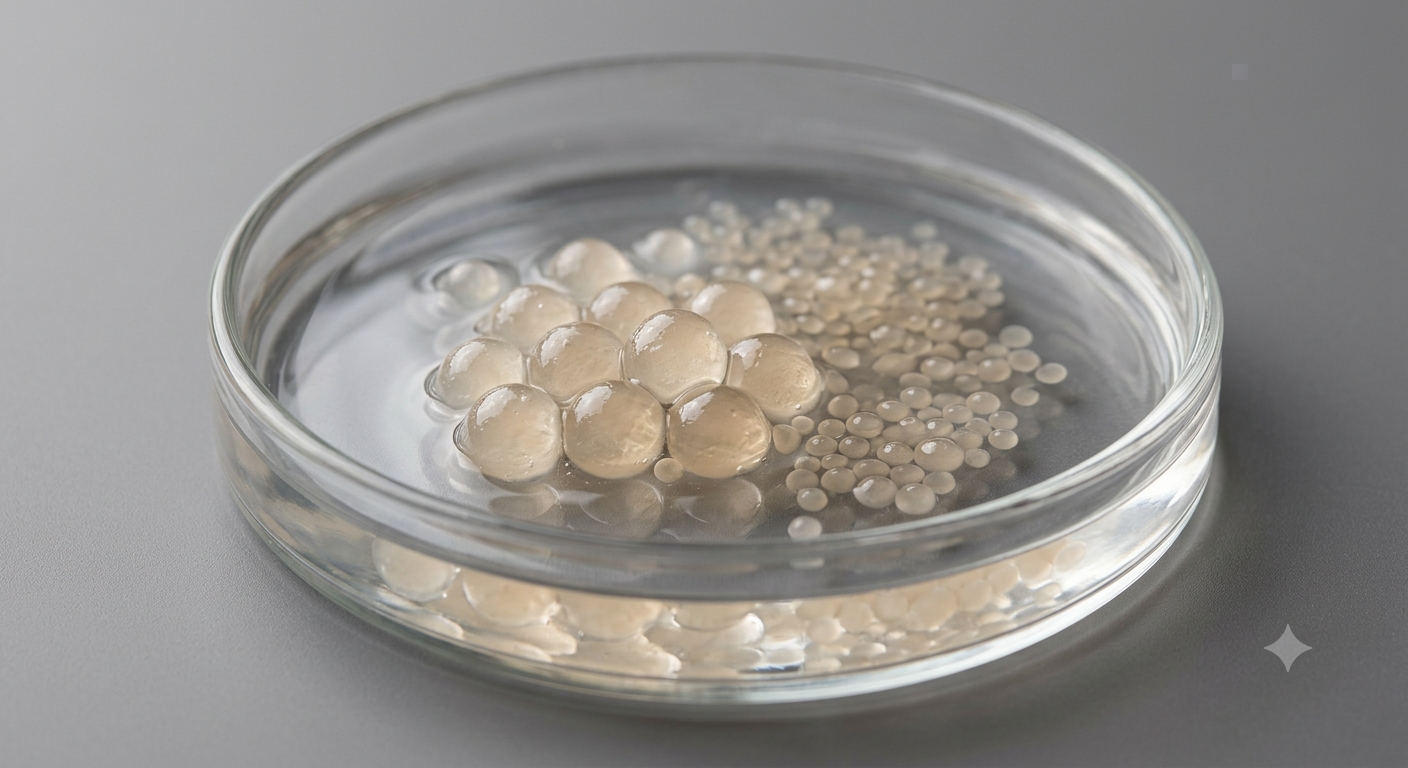
This is an AI generated illustration and does not represent actual product or service.
Plant-based emulsions have a stability problem that consumers notice fast: the oily layer that separates at the top of a bottle, the watery yogurt, the sauce that breaks in the fridge. Pea and fava protein isolates emulsify reasonably well when fresh, but many formulations cream or separate within days. Reformulating around this weakness usually means reaching for gums, starches, or higher protein loads — blunt tools that add cost and can dull texture.
A newly published patent application from the University of Alberta (US 2026/0191245 A1, filed by inventor Lingyun Chen) proposes a more precise fix: turn pulse proteins into monodisperse microgels — tiny, uniformly sized gel particles — and use the particle size itself as a formulation lever. Make them very small (about 3 µm) and they behave like Pickering emulsifiers that lock onto the oil-water interface. Make them larger (7–20 µm) and they behave more like thickeners that stabilize through steric hindrance and network-building in the surrounding liquid. Same raw material, same basic chemistry, two different stabilization mechanisms — selected by particle size alone.
The Problem with Existing Microgel Methods
The patent's background section is candid about why this hasn't been done well before. Coacervation, spray drying, and mechanical shearing — the standard ways to make protein microgels — produce particles with a wide range of sizes (high polydispersity) and often require significant energy input. Microfluidic devices can produce genuinely monodisperse microgels, but they need purpose-built equipment and output microgels at microliter-per-minute rates, which the application flags directly as a scale-up barrier.
The Method: Segregative Phase Separation
The approach borrows from a technique previously used with whey protein (the applicant's own prior work is cited among the references) and applies it to pulse proteins — specifically lentil and fava bean protein isolates — paired with alginate, the anionic polysaccharide derived from brown algae.
The mechanics are straightforward in principle. Protein and alginate solutions are mixed at a pH above the protein's isoelectric point (pH 8.5 for lentil, 7.5 for fava), so both molecules carry a negative charge. Rather than binding together (as they would through electrostatic complexation below the isoelectric point), the two negatively charged, mutually repulsive biopolymers separate into distinct phases — protein-rich droplets dispersed within an alginate-rich continuous phase. This is a water-in-water emulsion, not the oil-in-water kind most formulators think of first. Heating then denatures and gels the dispersed protein droplets into solid microgel particles, which are isolated once the surrounding polysaccharide is washed away.
The key formulation variable is the protein-to-polysaccharide mass ratio, which the patent claims can range from about 1:4 to 12:1, with a narrower and apparently better-characterized range of 5:4 to 10:1. Within that range, particle size scales predictably: lentil microgels are described at roughly 3 µm, 7 µm, and 15 µm; fava microgels at 3 µm, 7 µm, and 19 µm, corresponding to increasing protein-to-alginate ratios.
For an R&D team, that's the commercially interesting part. If size is genuinely tunable by adjusting a mixing ratio, you have a low-capital way to produce a family of ingredients from one process line rather than needing different equipment for different functional outcomes.
Two Stabilization Mechanisms, One Ingredient Platform
The application's most useful technical claim isn't just that these microgels stabilize emulsions — it's that different particle sizes stabilize emulsions differently, and the patent backs this with confocal microscopy and rheological data rather than assertion alone.
The smallest microgels (~3 µm) adsorb directly at the oil-water interface, forming classic Pickering emulsions. According to the specification, these stabilized both 25% and 50% oil emulsions with essentially no creaming after one month of storage — a striking contrast to untreated lentil-protein-stabilized emulsions, which the application states crept within a single day.
Larger microgels (7 µm and up) behave differently. Rather than sitting at the interface, they disperse through the continuous aqueous phase, where they stabilize emulsions through steric hindrance and by forming a viscoelastic, gel-like network. The patent reports that these larger-particle emulsions showed lower stability at 25% oil but performed comparably to the small-particle system at 50% oil — useful information for anyone trying to match microgel size to a specific product's fat content rather than assuming one particle size fits all applications.
The rheological data adds a layer worth flagging for formulators: emulsions stabilized by the smallest microgels showed storage modulus values that were nearly independent of frequency, consistent with a strong, elastic gel-like structure — the kind of thick, spoonable consistency the application explicitly connects to butter and yogurt-style textures. This is a case where the specification's business framing (low-fat spreads and dairy-style textures) is well supported by the mechanical data presented, not just asserted.
Why This Matters Beyond the Lab
A few implications stand out for people tracking the plant-based ingredient space:
It's a platform claim, not a single-product claim. The patent claims cover the microgel itself (independent of the alginate it's made with), the production method, and the resulting emulsions — a broad enough scope that a licensee could plausibly explore microgels made from other pulse proteins beyond lentil and fava, even though those aren't the working examples.
It targets a genuine, underserved gap. Whey protein microgels are well studied; plant protein equivalents are comparatively new territory, and the application says so directly. If pulse protein microgels can be produced at food-relevant scale with tunable functionality, that's a meaningfully different value proposition than simply substituting pea protein isolate for whey protein isolate in existing formulations — it's a new functional ingredient class, not a 1:1 swap.
The production method itself is the commercial pitch. No organic solvents, no high-pressure homogenization, no microfluidic hardware — just controlled mixing, pH adjustment, and heat. That's a meaningfully lower barrier to pilot-scale production than the microfluidic alternative the patent critiques, though "lower barrier than microfluidics" is not the same as "proven at industrial throughput," and the application doesn't provide production-rate data to benchmark against commercial homogenization lines.
Where This Leaves Ingredient and Brand Teams
For ingredient suppliers, the interesting angle is less "can I license this exact patent" and more "does particle-size-tunable functionality from a single process represent a better R&D framework than my current approach to plant protein emulsifiers." If a supplier can produce a family of microgels — some tuned for Pickering-style interfacial stabilization, others for bulk-phase thickening — from one process line and one raw material stream, that's an efficient way to serve multiple product categories (spreads, dairy alternatives, low-fat sauces) without maintaining separate ingredient SKUs.
For brand teams evaluating low-fat or plant-based product reformulations, the relevant question is whether a month of creaming-stability data and lab-scale rheology are enough to justify pilot trials — which, for most ingredient innovation pipelines, they typically are, provided real production-scale trials and extended shelf-life testing follow. As with most university-originated food patents, the gap between "demonstrated in a beaker" and "running on a plant floor" is where the real commercialization risk sits, and it's the gap any licensee or collaborator will need to close.


Trending Stories
Related Stories
Inspiring the food industry by showcasing hidden and valuable innovations from patents.
Subscribe to our monthly newsletter and never miss a story
We promise, we won't spam you!
We care about your data in our privacy policy.


FoodTechForesight.com
Founder and Editor