
Microwaves Just Made the World’s First Truly Crispy Fruit Cereal
CONFECTIONARY
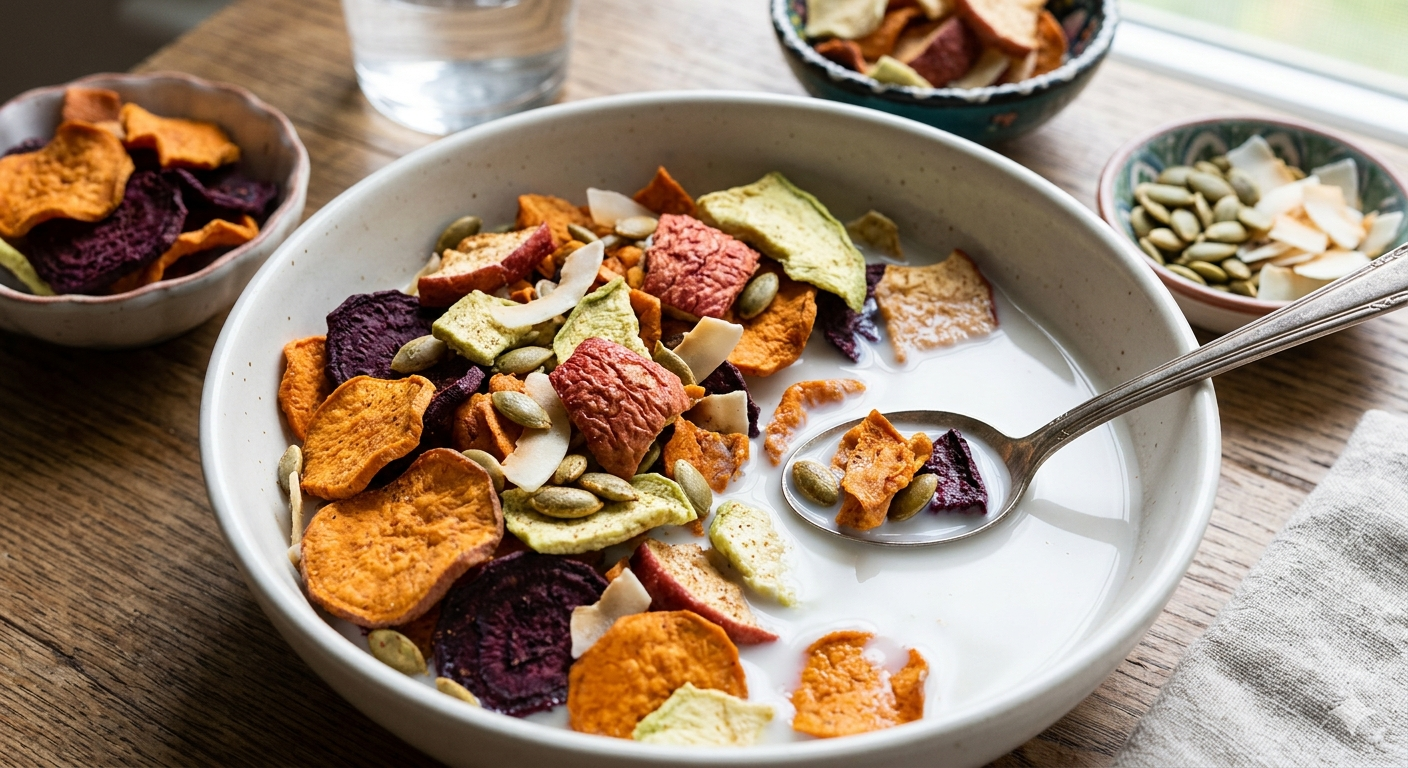
This is an AI generated illustration and does not represent actual product or service.
Imagine a breakfast cereal made entirely from fruit – no grains, no added sugar, yet it stays crunchy in milk just like your favourite corn flakes. A newly issued US patent (US12507716 B1) might have just made that a reality.
The patent, assigned to That’s It Nutrition, describes a clever two‑stage dehydration method that transforms simple plant materials – apples, sweet potatoes, carrots – into shelf‑stable, crispy snacks that can even be eaten as a grain‑free cereal. The key innovation? A second drying step using microwaves that not only drives moisture down to crispy levels but also pulls seasoning deep inside the plant tissue, creating flavour that’s integrated, not just dusted on the surface.
The Problem: Healthy Snacks That Feel Like a Compromise
Most fruit and vegetable snacks fall into two camps: soft, chewy dried fruit (think raisins or mango strips) or freeze‑dried puffs that dissolve instantly in liquid. Neither works well as a cereal. Traditional breakfast cereals rely on grains and often added sugars to achieve that signature crunch. And if you’ve ever tried to pour milk over a piece of dried apple, you know the result – a leathery, unappealing texture.
Consumers want minimally processed, plant‑based snacks that are both nutritious and enjoyable. The patent addresses this head‑on: a process that yields a product with low moisture (1–5%), high fiber, and a crispness that holds up even when soaked in milk.
The Two‑Stage Dehydration Process
The process is elegantly simple:
Step 1 – First Dehydration (Convective Hot Air)
The base plant material – say, apple slices cut into uniform squares or rectangles – is dried using hot air (conventional oven or dehydrator) until its moisture content falls to between 10% and 15% . At this stage, the pieces are dry enough to be stable but still retain a little internal moisture. That remaining water is crucial for the next step.
Step 2 – Seasoning
The partially dried pieces are seasoned. This can be anything from cinnamon powder to finely ground freeze‑dried strawberry, blueberry, mango or banana. Even simple salt for vegetable‑based snacks. No oil or binder is needed because the residual moisture makes the surface slightly tacky, helping the seasoning adhere.
Step 3 – Second Dehydration (Microwave)
Here’s where the magic happens. The seasoned pieces go into a microwave. As the microwave energy heats the food from the inside out, the last bit of remaining water evaporates – but as it does, it draws the seasoning particles into the porous structure of the plant tissue. The result isn’t just a coating; the flavour is absorbed into the matrix.
Final moisture: between 1% and 5% , ideally around 1.5–2.5% . At this level, the product becomes light, crisp, and audibly crunchy.
Why Microwave Makes All the Difference
The patent includes a head‑to‑head comparison (Example 2). When the second drying step used hot air instead of microwave, the seasoning stayed mostly on the outside. Much of it was lost during drying, and the final texture was chewy or leathery – not crisp. The microwave version, by contrast, showed visible penetration of the seasoning colour deep into the apple tissue, and the texture was airy, brittle, and satisfying.
This volumetric heating creates internal vapour pressure that expands the plant matrix and drives the seasoning inward. No other drying method seems to achieve the same combination of texture and flavour integration.
Real‑World Examples
The patent gives three working examples:
Apple + Strawberry: Apple slices first air‑dried to 10–15% moisture, dusted with freeze‑dried strawberry powder, then microwaved to <5% moisture. The result: a pink‑tinged, intensely fruity crisp that tastes of strawberry all the way through.
Apple + Cinnamon: Same process, but with cinnamon. A healthy, grain‑free “cinnamon toast” crunch.
Sweet Potato + Salt: Sweet potato slices (3–4 mm thick) air‑dried to 20–40% moisture (thicker pieces need a higher initial moisture), salted, then microwaved to 1–5% moisture. A savoury, crispy chip with salt beautifully integrated.
A Cereal That Works in Milk
Perhaps the most surprising claim is that this product can be used as a grain‑free breakfast cereal.
Example 4 describes the apple‑strawberry crisps poured into a bowl with chilled dairy milk. Unlike many dried fruit snacks that turn mushy, these crisps remained crunchy for an extended period. The low final moisture and the porous structure created by microwave drying are credited for this resilience. It also works with plant milks – almond, oat, soy.
Nutritionally, a one‑cup serving (about 30 g) delivers roughly 130 calories, 0 g added sugar, and 5 g of dietary fibre – thanks to the whole fruit base. No added fibre ingredients, no refined carbohydrates. Just fruit, dried smartly.
Why This Matters
For years, the healthy snack market has been stuck between “good for you but tastes like cardboard” and “delicious but ultra‑processed.” This patent offers a genuine middle path: whole plant ingredients, no added sugar, no grains, yet a texture and flavour experience that can compete with conventional cereals and crisps.
The two‑stage dehydration method is scalable, uses standard equipment (oven + microwave), and works with a huge variety of fruits and vegetables. It also opens the door to clean‑label products that don’t rely on gums, starches, or artificial flavourings to achieve crunch.
The Bottom Line
Would you eat a bowl of “apple‑strawberry crisps” for breakfast? According to this patent, you might soon have the option. And unlike sad, soggy dried fruit, it will actually crunch.
The innovation isn’t flashy – it’s a clever reordering of drying and seasoning steps. But that small change yields a product that could finally bridge the gap between what’s healthy and what people actually want to eat.


Trending Stories
Latest Stories
Inspiring the food industry by showcasing hidden and valuable innovations from patents.
Subscribe to our monthly newsletter and never miss a story
We promise, we won't spam you!
We care about your data in our privacy policy.


FoodTechForesight.com
Founder and Editor