
NC State's CO2 Trick Could Speed Up Whiskey Aging — and Clean Up Paper Mills
BEVERAGES
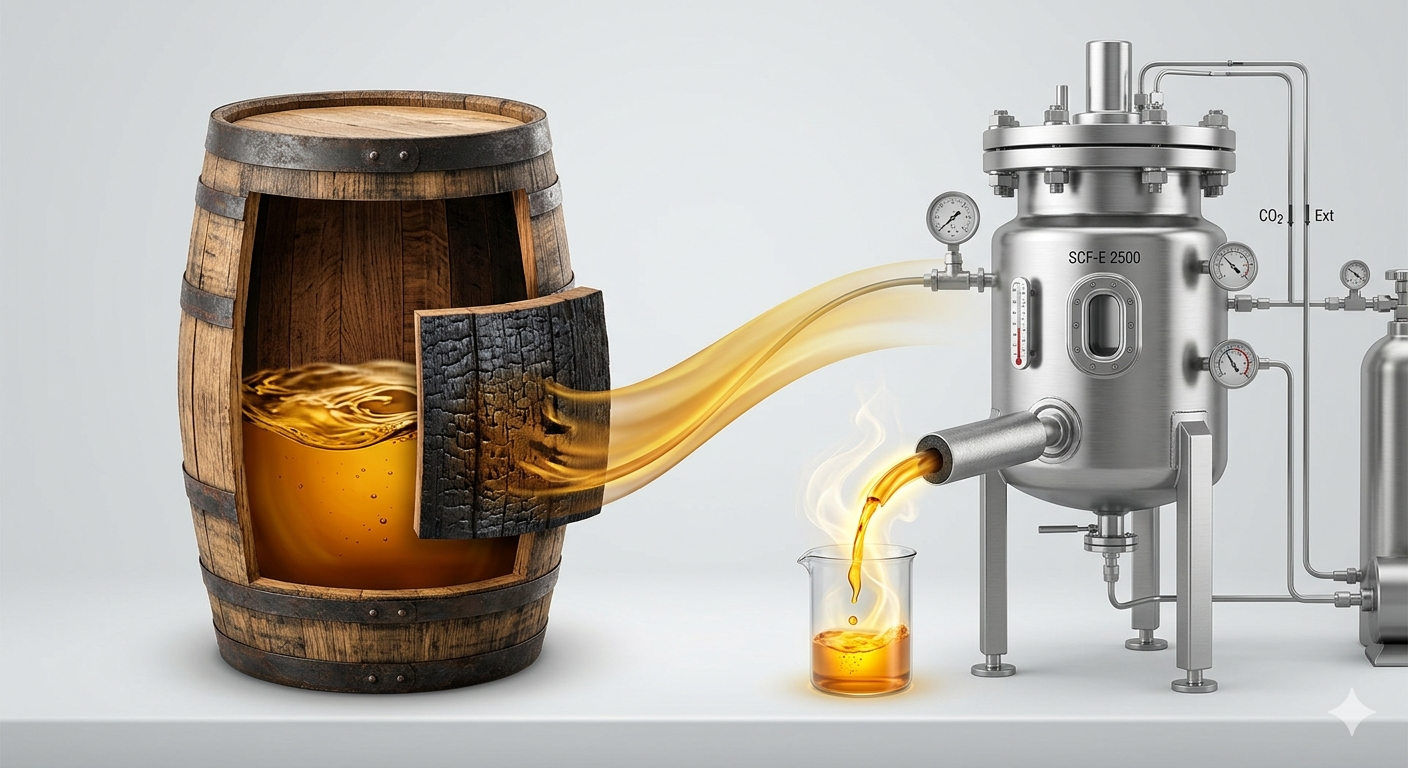
This is an AI generated illustration and does not represent actual product or service.
Whiskey aging is one of the food and beverage industry's most stubborn bottlenecks. A spirit sits in a charred oak barrel for years, slowly pulling out lignin-derived phenolics, lactones, and aldehydes that give bourbon its vanilla, caramel, and spice character — while the producer pays for warehouse space, evaporation losses (the "angel's share"), barrel maintenance, and the risk of contamination, all for a process nobody can meaningfully speed up.
A new patent application from North Carolina State University, filed by inventors Marko Hakovirta and Salonika Aggarwal (US 2026/0159791 A1, published June 11, 2026), takes direct aim at that bottleneck — and then, almost as an aside, applies the same core technique to an entirely unrelated industrial waste stream. It's a patent built around one extraction method serving two very different masters: flavor chemistry for whiskey makers, and odor control for the pulp and paper industry.
The Core Idea: Supercritical CO2 as a Solvent for Wood Chemistry
The method itself is conceptually simple, even if the underlying chemistry is not. The patent describes contacting a lignocellulosic matrix — in this case oak wood — with supercritical carbon dioxide. "Supercritical" here means CO2 held above its critical point (304.25 K and 7.39 MPa, or roughly 31°C and 73.8 bar), a state where it behaves with liquid-like solvating power and gas-like diffusivity. That combination lets it penetrate wood structure and selectively dissolve out specific compound classes without the use of organic solvents or high heat.
For the whiskey application, the target compounds are exactly the molecules barrel-aging is known for: lactones (including cis- and trans-3-methyl-4-octanolide, the "whiskey lactones" responsible for coconut and oak notes), aldehydes (vanillin, furfural, syringaldehyde), and phenolics (guaiacol, eugenol, the cresol isomers). The patent specifies this extraction can be performed on oak from American, French, or red oak species, optionally charred or smoked beforehand, and optionally on wood already harvested from a barrel previously used to age whiskey, brandy, rum, or sherry — meaning the technology could, in principle, recover flavor value from barrels at the end of their useful life rather than letting that chemistry go to landfill or low-value mulch.
Processing conditions are described across reasonably wide ranges: pressures of roughly 2,500–5,000 psi (with a preferred window of 3,000–3,500 psi), temperatures of 50–80°C (preferred 60–70°C), and CO2-to-wood mass ratios from 5:1 to 25:1. The patent also describes a cyclical extraction approach — running several short (1–10 minute) extraction pulses rather than one continuous hour-long extraction — which it claims can reduce total extraction time and improve yield by avoiding CO2 saturation partway through the process.
A Genuinely Interesting Second Application: Desulfurizing Kraft Lignin
This is where the patent gets more strategically interesting than a standard "extract flavor from wood" filing. The same supercritical CO2 method is applied to a second, chemically unrelated matrix: Kraft lignin, the lignin-rich byproduct of the dominant pulping process used in the paper industry.
The background section lays out a genuinely underexploited opportunity. Global isolated lignin production is around 1.3 million tons annually, but that's a small fraction of the roughly 70 million tons of lignin produced worldwide through pulping — the overwhelming majority of which is simply burned onsite for process heat rather than isolated and sold as a chemical feedstock. Lignin has real potential value as a renewable input for adhesives, coatings, plastic packaging, carbon fiber, composite materials, antioxidants, and sunscreens. The patent identifies the reason more of it isn't captured for higher-value use: Kraft lignin typically retains 2–3% total sulfur from the pulping chemistry (sodium sulfide is part of the Kraft process), and that sulfur produces a foul smell that limits where the lignin can be used.
The patent's claimed fix is the same supercritical CO2 contacting method, applied to Kraft lignin instead of oak wood, which it says extracts organic sulfur compounds out into an "oil-like" extractant with a concentrated sulfur smell, leaving behind a desulfurized lignin. According to the application, this can reduce total sulfur in the lignin to below 0.5%, 0.3%, or even 0.1%, and in some embodiments yields lignin described as having no detectable sulfur or sulfur smell at all — alongside an incidental ~60% reduction in moisture content.
If that holds up at scale, it's a real value-unlock: a low-cost, solvent-free process (CO2 is non-toxic, leaves no residue, and is easily separated from the extract by depressurization) that could make a much larger share of the world's lignin output viable as a feedstock for adhesives, packaging, or composite materials, rather than just being burned for heat. For pulp and paper companies sitting on large volumes of an underutilized byproduct, that's a meaningfully different economic proposition than the status quo.
What's Genuinely Missing From This Disclosure
This is where readers should calibrate expectations carefully, because this filing reads very differently from the heavily data-supported industry patents typically covered here.
There are no working examples. Unlike most commercial patents in this space, this application contains no embodiments, no comparative examples, no extraction yield data, no sensory panel results, and no measured sulfur content before-and-after a specific test run. Every numerical range — pressure, temperature, extraction time, sulfur reduction percentages — is presented as a claimed range without an accompanying data table showing it was actually achieved under stated conditions. That's not unusual for an early-stage university filing built on provisional patent priority (this application claims priority to a April 2024 provisional), but it does mean none of the headline numbers in this article — including the "below 0.1% sulfur" and "no detectable sulfur smell" claims — should be read as independently verified results. They are claimed capabilities, not measured outcomes.
Interestingly, the same research team has already published peer-reviewed work using this exact technique. Hakovirta (a named inventor on the patent) and Aggarwal (the patent's co-inventor and lead author here) co-authored a 2019 study in Industrial & Engineering Chemistry Research — "Removal of Water and Extractives from Softwood with Supercritical Carbon Dioxide" — that applies the same sCO2 extraction platform to pine wood, in the context of industrial wood drying for oriented strand board (OSB) manufacturing. It's a different application (drying and resin-compatibility, rather than whiskey flavor or lignin desulfurization), but it's built on the same core science, run on the same equipment (an OCO Laboratories Super C unit, the identical apparatus named in the patent), and it offers a useful window into how this technology actually behaves under real experimental conditions.
A few of the findings are directly relevant to understanding why the patent's claims are framed the way they are:
Water removal works by displacement, not just evaporation or diffusion — which is the whole efficiency story. The researchers found that water's measured concentration in the sCO2 phase ran 3–4 times higher than its known solubility limit under the same conditions. The explanation: sCO2 doesn't just dissolve water up to a solubility ceiling, it physically displaces bound water within the wood structure, in a manner similar to how CO2 displaces brine in geological formations. This is a meaningfully different (and more energy-efficient) mechanism than evaporative drying, and it's part of why the broader sCO2 platform is attractive industrially — it's not just "extraction," it's active displacement.
Extractives come out cleanly above a clear pressure threshold. In the pine chip trials, resinous extractives — di- and triglycerides, fatty acids like octanoic and decanoic acid, and terpenes such as α- and β-pinene — were only released at pressures above 13.8 MPa (roughly 2,000 psi), with yield increasing further as pressure climbed toward 27.6 MPa. That threshold sits comfortably within the pressure range the patent claims (2,500–5,000 psi, or about 17–34 MPa), which is a nice piece of continuity: the inventors appear to be working within a pressure window they've already shown, in published work, reliably releases lignin-associated compounds from wood.
The extracted material is chemically tied to the lignin fraction. GC/MS analysis showed that the oily condensate pulled from wood flakes had a composition profile strikingly similar to sCO2 extract obtained separately from isolated lignin — with organic carbon content of 56% and 62%, respectively. In other words, the team has already shown that sCO2 selectively accesses lignin-associated hydrophobic compounds in wood. That's a nice scientific throughline to the patent's second application: extracting organic sulfur compounds from Kraft lignin is, mechanistically, a close cousin of what they demonstrated here.
The extraction process doesn't appear to degrade wood structure. SEM imaging and contact-angle measurements showed no meaningful difference between sCO2-treated wood and conventionally heat-dried wood, suggesting the extraction leaves the underlying material structurally intact. That's a relevant data point for the patent's framing of the "extracted matrix" (leftover oak wood, or desulfurized lignin) as having continued downstream utility rather than being degraded waste.
The economics looked favorable even at a preliminary stage. The paper's cost analysis found sCO2 treatment could beat conventional thermal drying on both capital and operating costs — largely because extractives are recovered as a saleable byproduct (priced comparably to tall oil) rather than treated as emissions requiring pollution control equipment, and because water displacement requires far less energy than evaporation. It's worth knowing this team has already built and stress-tested a version of this economic argument in a peer-reviewed setting, since cost-effectiveness is central to the commercial case for both whiskey flavor extraction and lignin valorization.
Taken together, this prior work is a strong signal of technical depth behind the patent: the inventors aren't proposing sCO2 extraction of lignocellulosic material as an untested idea, they're extending a platform they've already validated experimentally, on closely related chemistry, using the same equipment and operating conditions named in the current filing.
Commercial and Strategic Implications
Treating this as an early-stage but credible platform technology rather than a near-market product, a few implications stand out:
For whiskey and spirits producers, an oak-barrel-essence extract — if it performs as claimed — opens up a genuinely different cost and speed lever than anything currently available. Barrel aging's biggest costs (warehouse space, time, evaporation loss, barrel replacement) are largely fixed by the physics of slow liquid-wood contact over years. A concentrated extractant that could accelerate flavor development, finish a younger spirit, or be blended to extend barrel life would target the industry's most persistent cost center directly. The realistic near-term use case is probably flavor enhancement or finishing rather than full barrel-aging replacement — regulatory definitions of "whiskey" and "bourbon" in most jurisdictions, including the U.S., require actual wood barrel aging, so an extractant likely can't be used to label a product as traditionally aged whiskey even if it could replicate the flavor profile. Its more plausible commercial lane is as a flavoring agent for other categories: flavored spirits, RTD cocktails, non-traditional aged-spirit alternatives, or food and beverage flavoring more broadly, exactly as the patent's claim language anticipates.
For pulp and paper companies, the lignin desulfurization angle may be the more economically significant story long-term, even though it will get less attention than the whiskey hook. If a CO2-based process can reliably take Kraft lignin's sulfur content down by an order of magnitude without the cost and complexity of chemical treatment, it materially changes the calculus for lignin valorization — a topic the pulp and paper industry has circled for years without a clean, low-cost solution. Worth noting: this would also be a case of a food-and-beverage-adjacent extraction technology generating IP relevant to packaging and materials science, reinforcing how thin the boundary between "food tech" and "materials tech" patents has become.
For both applications, the byproduct question matters. The patent frames the extracted matrix — the leftover oak wood after whiskey-compound extraction, and the desulfurized lignin after sulfur removal — as having ongoing utility, not just the extractant. Desulfurized lignin is explicitly positioned as a chemical feedstock for adhesives, coatings, packaging, carbon fiber, and sunscreens. That dual-output framing (valuable extract and upgraded leftover matrix) is the kind of circular-economy positioning that's increasingly attractive to ESG-minded investors and to companies under pressure to find higher-value uses for industrial sidestreams.
What to Watch
This is a technology worth tracking. The questions that matter most for anyone evaluating it — extraction yields for the specific compounds claimed (whiskey lactones and phenolics from oak, organic sulfur from Kraft lignin), sensory validation against genuine barrel-aged whiskey, and real-world sulfur reduction figures from pilot-scale lignin runs — will likely surface as this application moves through prosecution and as the team publishes further work. But the inventors' 2019 paper is a strong head start: it shows this exact sCO2 platform, run on the same equipment and within the same operating envelope, reliably extracting lignin-associated compounds from related wood material, with a peer-reviewed mechanistic explanation and a preliminary but credible cost case behind it. That's a meaningfully more grounded starting point than most early-stage university patent filings get.


Trending Stories
Related Stories
Inspiring the food industry by showcasing hidden and valuable innovations from patents.
Subscribe to our monthly newsletter and never miss a story
We promise, we won't spam you!
We care about your data in our privacy policy.


FoodTechForesight.com
Founder and Editor