
Nestlé’s New Iron-Fortified Dairy Patent: Solving Taste, Texture, and Nutrition in One Process
NUTRACEUTICALSDAIRY & ALTERNATIVES
This is an AI generated illustration and does not represent actual product or service.
Iron fortification has long been one of the most stubborn challenges in the food industry—especially in dairy. While the nutritional need is undeniable, the execution has always come with trade-offs. Add iron, and you risk metallic off-notes. Try to mask it, and you complicate formulations. Push for better texture, and you often end up relying on stabilizers or higher fat content.
A recently published patent from Nestlé (WO2026/041511) offers a compelling shift in how this problem is approached. Rather than treating iron as an external additive that must be managed, the invention integrates iron directly into the dairy protein system—transforming it into both a nutritional and structural component of the product.
This seemingly subtle shift has significant implications for product development, particularly in clean-label dairy and functional nutrition.
Rethinking Iron Fortification in Dairy
Iron, particularly in its soluble forms, is chemically reactive. In dairy systems, this reactivity often leads to oxidation, resulting in undesirable metallic flavors and aromas. At the same time, many iron compounds that are more stable—such as ferric pyrophosphate—tend to have lower bioavailability or poor solubility, limiting their nutritional effectiveness.
The challenge is therefore twofold:
Maintain high bioavailability of iron
Preserve or enhance sensory quality (taste, texture, mouthfeel)
Historically, achieving both simultaneously has proven difficult.
The Core Insight: Make Iron Part of the Protein System
Nestlé’s approach is built around a deceptively simple concept: instead of adding iron as a free mineral, bind it to casein proteins within the milk system.
In the patented method, iron is introduced into a dairy composition containing casein and whey proteins. Under controlled conditions, the iron binds to casein, forming what the patent describes as iron-casein complexes.
This binding step is critical. Casein, which naturally exists as micellar structures in milk, has a unique ability to interact with minerals. By attaching iron directly to these structures, the process effectively “hides” the iron within the protein matrix, reducing its reactivity in the surrounding system.
But the innovation does not stop there.
Controlled Aggregation: Turning Structure into Function
After iron binding, the system undergoes homogenization and heat treatment. This is where the second layer of functionality emerges.
During heating—typically between 60°C and 110°C for short durations—the interaction between casein and whey proteins changes. The presence of iron appears to influence this behavior, leading to the formation of protein agglomerates composed of casein and whey proteins, with particle sizes in the range of approximately 3 to 50 microns.
These aggregates are not random defects—they are engineered structures.
From a sensory perspective, particle size in this range is highly relevant. It sits within a window that enhances perceived creaminess and mouthfeel without introducing graininess or sedimentation. In essence, the process creates a microstructure that mimics the richness typically associated with higher fat content.
This is particularly important for low-fat or reduced-fat dairy products, where maintaining texture has always been a major hurdle.
Why Previous Approaches Fell Short
Earlier attempts to improve dairy texture often relied on inducing protein aggregation using divalent cations such as calcium. While effective in structuring proteins, these approaches created complications when combined with iron fortification.
The combination of calcium-induced aggregation and iron addition frequently resulted in poor sensory outcomes, especially metallic taste and odor.
Nestlé’s method sidesteps this issue by allowing iron itself—specifically in its ferric (Fe³⁺) form—to play a dual role. It not only contributes to nutritional fortification but also participates in structuring the protein network.
From a molecular standpoint, ferric ions form stronger coordination bonds with proteins than divalent ions like calcium. This stronger interaction likely contributes to more controlled and stable aggregation, reducing the need for additional minerals while improving overall product performance.
Bioavailability Without Compromise
One of the most striking aspects of the patent is that the structural improvements do not come at the expense of nutrition. On the contrary, the iron-casein complexes demonstrate high levels of bioavailability, with reported relative absorption in the range of 90–100%.
This is significant because it addresses a common trade-off in fortification strategies. Highly bioavailable iron sources are often the most reactive and sensory-disruptive. By embedding iron within the casein structure, the process appears to preserve its nutritional accessibility while minimizing negative interactions in the product.
Clean Label Through Process, Not Additives
Another important implication lies in formulation strategy.
In many dairy products, especially low-fat variants, texture is typically adjusted through the addition of hydrocolloids, emulsifiers, or other stabilizers. While effective, these ingredients can complicate labels and run counter to consumer demand for simplicity.
The described method offers an alternative: achieving desirable texture through controlled protein structuring rather than external additives. The patent explicitly notes that the resulting products can achieve improved sensory performance with reduced or no need for additional stabilizers.
This aligns closely with the broader industry shift toward clean-label solutions driven by process innovation rather than ingredient complexity.
Flexibility for Industrial Application
From a manufacturing standpoint, the process is designed to integrate into conventional dairy processing workflows.
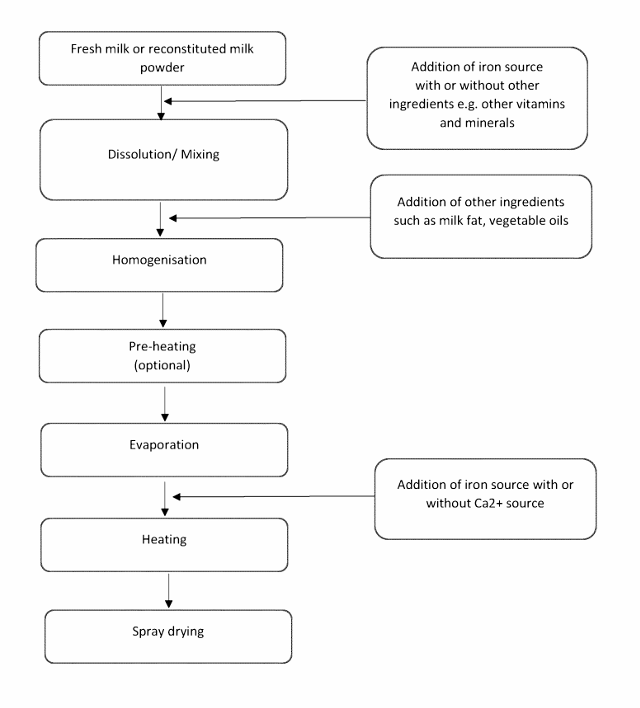
Iron can be added at different stages—either before or after evaporation—and the method is compatible with standard operations such as homogenization, heat treatment, and spray drying.
This flexibility is important because it lowers the barrier to adoption. Rather than requiring entirely new infrastructure, the innovation can be layered onto existing production systems with relatively minor adjustments.
The resulting compositions can be used across a wide range of applications, including liquid milk, powdered milk, and ready-to-drink products.
Conclusion
Nestlé’s iron-fortified dairy patent offers a compelling example of how processing science can unlock new functionality in familiar ingredients. By integrating iron into the protein matrix and leveraging controlled aggregation, the method simultaneously addresses three longstanding challenges: nutritional efficacy, sensory quality, and formulation simplicity.
For the food industry, the message is clear. The future of functional foods may not lie in adding more, but in understanding—and redesigning—the systems we already have.


Trending Stories
Latest Stories
Inspiring the food industry by showcasing hidden and valuable innovations from patents.
Subscribe to our monthly newsletter and never miss a story
We promise, we won't spam you!
We care about your data in our privacy policy.


FoodTechForesight.com
Founder and Editor